
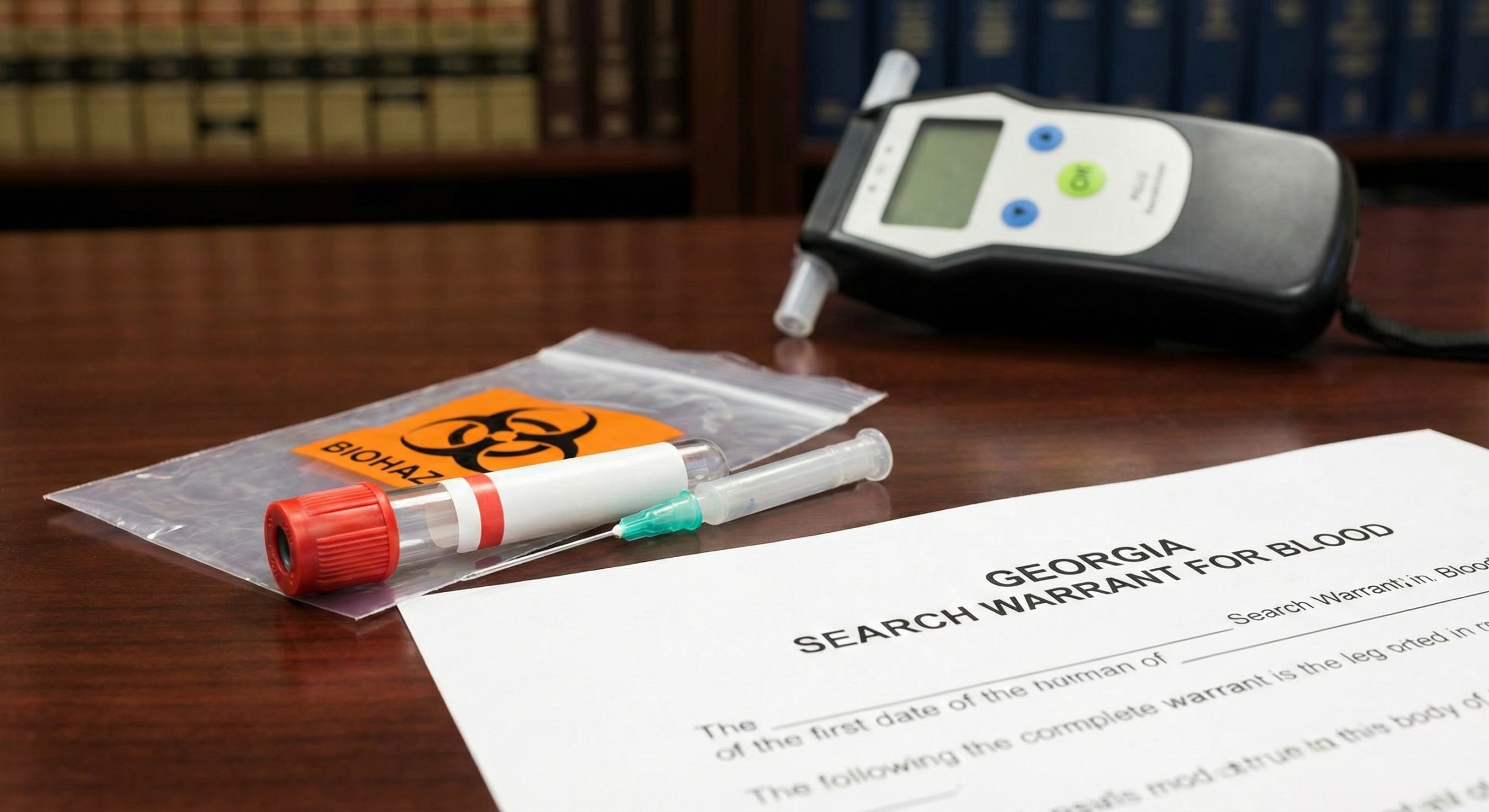
The breathalyzer was the undisputed heart of a drunk driving prosecution over decades. However, when you are pulled over in Fulton, DeKalb or Cobb County today you are entering into a completely different legal environment. Georgia law enforcement is so much more focusing on breath tests in 2026 and instead targeting your veins in direct attacks.
It is imperative to gain insight into the technical and legal causes of this change of breath to blood, as any person subjected to an indictment during the contemporary period of Georgia DUI law enforcement must understand.
The Catalyst: The Collapsing of the Breath Test.
The change started with a ground-breaking verdict of the Georgia Supreme Court (Elliott v.). State), a decision that said that citizens are entitled to refuse a breath test administered by the state under the Georgia Constitution, and that refusal could not be used at trial as evidence of their guilt.
Since using a breathalyzer presupposes a positive physical act, the court held that coerced to blow into the device, or even convicted of refusal in the jury, against self-incrimination. The breath test virtually lost its prosecutorial strength virtually overnight.
The Rise of Blood Warrants: The Countermove by the State.
Law enforcement agencies changed to counter their inability to weaponize their breath test refusals. Nowadays, when you are asked to take a roadside or station breath test, the officers do not just issue you a ticket and send to a holding cell. Instead, they directly call an on call magistrate judge to obtain a search warrant to have blood drawn.
A blood draw is a passive one unlike a breath test. When a judge issues a warrant on the basis of the probable cause as claimed by the officer (which in most cases is due to the odor of alcohol, or stated alleged erratic driving), the state may coerce a medical professional to take your blood with or without your consent.
Criminalistics Deficits of Blood Evidence.
Prosecutors are fond of blood evidence testing since juries subconsciously regard the results of clinical laboratories as something beyond question. Nevertheless, an experienced DUI Lawyer Atlanta can say that the blood test brings a colossal chain of human and procedural variables, which leaves many chances of making a solid defense.
The Specificity of the Warrant.
The Fourth Amendment demands that the search warrants must be very specific. One of the key areas of contention in 2026 is a warrant that expressly permits something. When a magistrate signs a warrant expressly to test your blood on alcohol, the state crime lab will not be entitled to test the same sample of blood on prescription drugs or cannabis unless a second, separate warrant is obtained. In case they cross the boundaries, the evidence may be shut out.
Chain of Custody Failures
Blood evidence does not just transport itself out of your arm to a courtroom. It should be lawfully deducted by a certified phlebotomist, well capped, refrigerated, shipped throughout the state, and registered into the Georgia Bureau of Investigation (GBI) crime laboratory. The absence of any explanation of any lapse or delay in this chain of custody raises reasonable doubt as to the integrity of the sample.
Storage and Fermentation Problems.
Blood is organic matter. The blood actually can start to ferment in case the vials are not correctly inverted to shake with the preservative powder or when the vials are stored in a hot police cruiser before refrigeration. It is a fermentation process that makes its own ethanol and this creates a fake reading of a Blood Alcohol Concentration (BAC) that has nothing to do with the alcohol you have imbibed.
Defending the Modern DUI
It now takes much more than cross-examination of an officer regarding a road side walk-and-turn test to fight a DUI case. It involves a violent attack on judicial warrants, laboratory procedures and forensic chemistry.
When forced to give a blood draw, you require a person who is well versed with the science of forensic evidence on the same note as the law. His hiring of James Yeargan as a lawyer in Atlanta to represent him in DUI implies having a lawyer who has knowledge on how to question the laboratory reports provided by GBI, question the scope of the warrant issued by the magistrate, and put the state to the utmost examination according to the law.
Do not believe that one of the results of the blood test concludes your case. When an experienced DUI Attorney Atlanta is researching the forensic evidence, blood draw can easily become the best weapon of the prosecution and the major liability of the prosecution.
